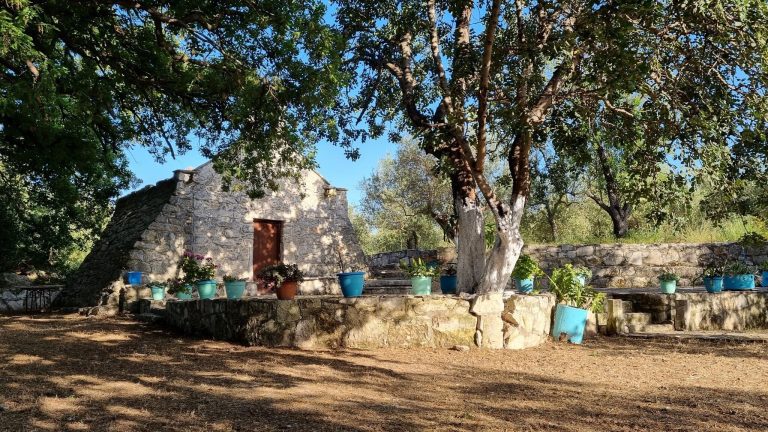
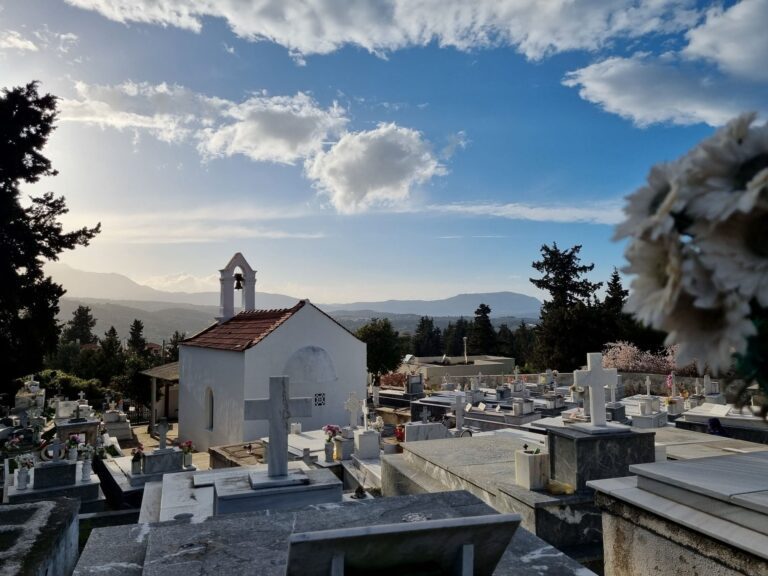
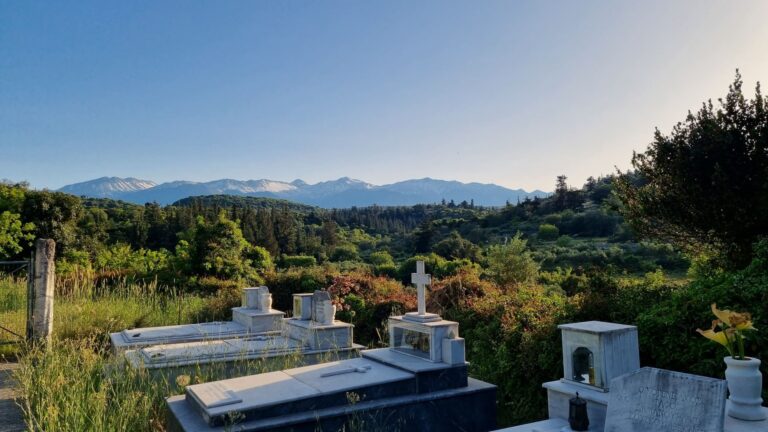
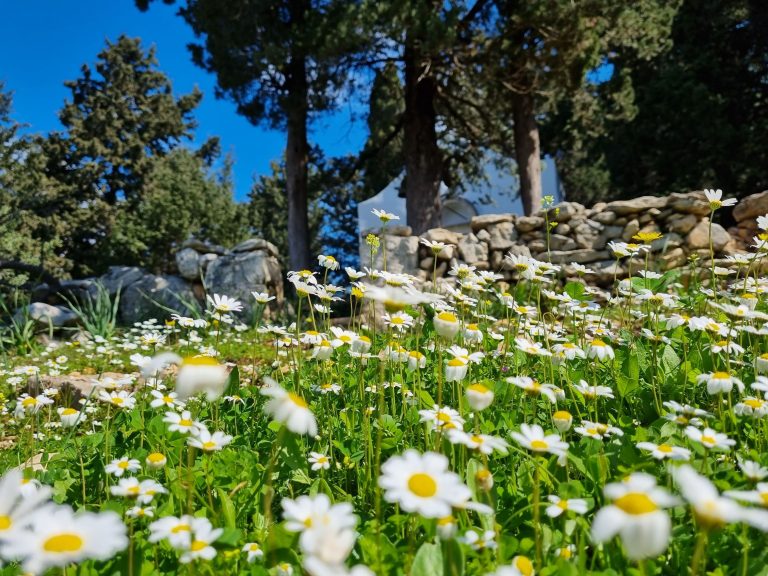
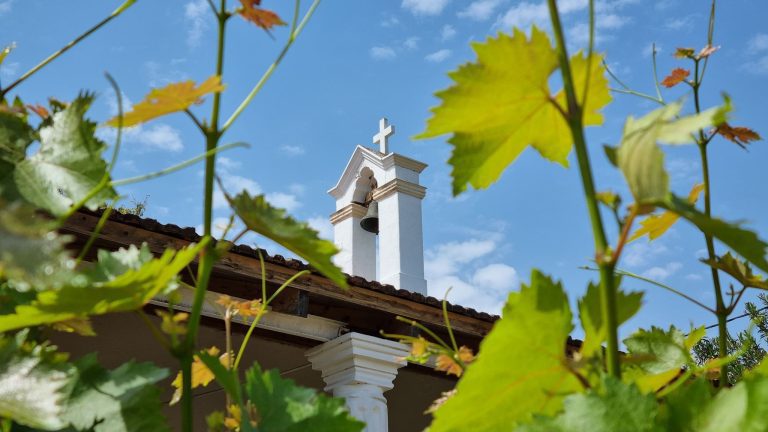
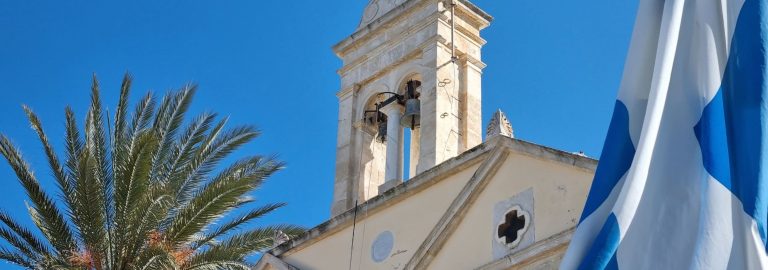
The Church of Saint Phanourios can be found on the back road from Gavalochori to Vamos. Steps take you through a metal arch with a cross on the top down to a blue metal gate that lets you into the courtyard of this tiny white church. Although the church is usually locked, you can see much of the inside through the windows. The wooden benches outside the church also provide a meditative resting spot from which you can take in the lovely view toward Souda Bay. Saint Phanourios (Agios Fanourios, Άγιος Φανούριος) is a special saint for Cretans because he is said to have saved many Cretans from death when they resisted Turkish rule during the 17th through 19th centuries.
From the main square of Gavalochori, take the road that leads to Vamos (Βάμος). After leaving the square, the road winds to the right and passes a defunct taverna. Soon on the right you will see an old well on a stone plaza. At that point, turn left and follow the road up the hill to Vamos, taking right turns whenever you have the option. You will find the Church of Saint Phanourios on a particularly steep curve halfway up the hill.
The church was the vision of Gavalochori resident Isabella Frantzeskakis, mother of Kostas Frantzeskakis, who, together with his wife Evaggelia Vouraki, owns the Floraplant Garden Center in Kalyves and Chania. One night, Isabella had a dream that seemed very real in which something terrible was happening but someone was protecting her. In the dream, she saw Saint Phanourious standing with a candle in the place where the church is now. The dream was so intense that she decided to build a church at that location, and she received permission from the priest and then enlisted the help of the villagers to finance and build it. A sign on the church reads, “The Holy Temple was constructed in the year 1862 with the financial aid of Isabella Franstzeskaki, the Priest Emmanouil Vorinaki and the villagers. The plot of land was gifted by Apostolakis Grigorios.”
Little is known about Saint Phanourios beyond the fact that he lived sometime during the 2nd and 4th centuries AD and was persecuted because of his Christian beliefs. Everything that is known about him was revealed by an icon discovered between 1300 and 1500 AD in either Rhodes or Cyprus, several centuries after he lived. Arabs were pillaging the ruins of an ancient church and found a group of icons buried there, all of which were in a state of decay except for the one depicting Saint Phanourios, which appeared to be new. When the Arabs discarded the icon, a group of monks who had been hiding nearby picked it up and were amazed at not only the condition of the icon but its content.
The icon depicted Saint Phanourios as a young soldier holding a cross with a candle taper at the top. The frames around a saint’s icon tell the story of the kind of tortures endured in the name of Jesus, and in the icon, Saint Phanourios was surrounded by 12 frames. Each depicted him enduring a different form of torture—being stoned, tied to a rack, being slashed, in prison, being questioned by a judge, tied to a frame, being burned with candles, tied to a post, thrown to wild animals, crushed by a large rock, and holding hot coals. In the final scene, Saint Phanourios was shown standing in the middle of a fire with his arms raised in prayer. The frames were interpreted to mean that Saint Phanourios was an apparently indestructible instrument of God, providing sufficient evidence to be recognized as a saint in the Greek Orthodox Church.
Saint Phanourios’s name sounds similar to the Greek verb fanerono (Φανερώνω), which means “to reveal” or “to disclose.” For this reason, he is sometimes called Saint Phanourios the Newly Manifest. People pray to Saint Phanourios to help them find lost objects, to reveal lost or hidden spiritual matters, to find new meaning in life, to reveal actions that should be taken, and to restore lost health.
In the evening before Saint Phanourios’s name or feast day, which is August 27 (the anniversary of the date when the icon was discovered in the ruins of the church), many villagers bake a fanouropita (Φανουρόπιτα). This small cake of flour, sugar, cinnamon, and oil is traditionally made with either seven or nine ingredients (holy numbers in the Greek Orthodox Church) and is made to honor and give thanks to Saint Phanourios. Villagers bring their cakes to the Church of Saint Phanourios to religious services in the morning of the feast day to be blessed and distributed among the parishioners (the service begins at about 7:30). The cake has another function as well. Single people are encouraged to put a piece of fanouropita under their pillows in the belief that it will induce dreams of their future wife or husband.
The Church of Saint Phanourios can be found on the back road from Gavalochori to Vamos. Steps take you through a metal arch with a cross on the top down to a blue metal gate that lets you into the courtyard of this tiny white church. Although the church is usually locked, you can see much of the inside through the windows. The wooden benches outside the church also provide a meditative resting spot from which you can take in the lovely view toward Souda Bay. Saint Phanourios (Agios Fanourios, Άγιος Φανούριος) is a special saint for Cretans because he is said to have saved many Cretans from death when they resisted Turkish rule during the 17th through 19th centuries.
From the main square of Gavalochori, take the road that leads to Vamos (Βάμος). After leaving the square, the road winds to the right and passes a defunct taverna. Soon on the right you will see an old well on a stone plaza. At that point, turn left and follow the road up the hill to Vamos, taking right turns whenever you have the option. You will find the Church of Saint Phanourios on a particularly steep curve halfway up the hill.
The church was the vision of Gavalochori resident Isabella Frantzeskakis, mother of Kostas Frantzeskakis, who, together with his wife Evaggelia Vouraki, owns the Floraplant Garden Center in Kalyves and Chania. One night, Isabella had a dream that seemed very real in which something terrible was happening but someone was protecting her. In the dream, she saw Saint Phanourious standing with a candle in the place where the church is now. The dream was so intense that she decided to build a church at that location, and she received permission from the priest and then enlisted the help of the villagers to finance and build it. A sign on the church reads, “The Holy Temple was constructed in the year 1862 with the financial aid of Isabella Franstzeskaki, the Priest Emmanouil Vorinaki and the villagers. The plot of land was gifted by Apostolakis Grigorios.”
Little is known about Saint Phanourios beyond the fact that he lived sometime during the 2nd and 4th centuries AD and was persecuted because of his Christian beliefs. Everything that is known about him was revealed by an icon discovered between 1300 and 1500 AD in either Rhodes or Cyprus, several centuries after he lived. Arabs were pillaging the ruins of an ancient church and found a group of icons buried there, all of which were in a state of decay except for the one depicting Saint Phanourios, which appeared to be new. When the Arabs discarded the icon, a group of monks who had been hiding nearby picked it up and were amazed at not only the condition of the icon but its content.
The icon depicted Saint Phanourios as a young soldier holding a cross with a candle taper at the top. The frames around a saint’s icon tell the story of the kind of tortures endured in the name of Jesus, and in the icon, Saint Phanourios was surrounded by 12 frames. Each depicted him enduring a different form of torture—being stoned, tied to a rack, being slashed, in prison, being questioned by a judge, tied to a frame, being burned with candles, tied to a post, thrown to wild animals, crushed by a large rock, and holding hot coals. In the final scene, Saint Phanourios was shown standing in the middle of a fire with his arms raised in prayer. The frames were interpreted to mean that Saint Phanourios was an apparently indestructible instrument of God, providing sufficient evidence to be recognized as a saint in the Greek Orthodox Church.
Saint Phanourios’s name sounds similar to the Greek verb fanerono (Φανερώνω), which means “to reveal” or “to disclose.” For this reason, he is sometimes called Saint Phanourios the Newly Manifest. People pray to Saint Phanourios to help them find lost objects, to reveal lost or hidden spiritual matters, to find new meaning in life, to reveal actions that should be taken, and to restore lost health.
In the evening before Saint Phanourios’s name or feast day, which is August 27 (the anniversary of the date when the icon was discovered in the ruins of the church), many villagers bake a fanouropita (Φανουρόπιτα). This small cake of flour, sugar, cinnamon, and oil is traditionally made with either seven or nine ingredients (holy numbers in the Greek Orthodox Church) and is made to honor and give thanks to Saint Phanourios. Villagers bring their cakes to the Church of Saint Phanourios to religious services in the morning of the feast day to be blessed and distributed among the parishioners (the service begins at about 7:30). The cake has another function as well. Single people are encouraged to put a piece of fanouropita under their pillows in the belief that it will induce dreams of their future wife or husband.
| Cookie name | Active |
|---|