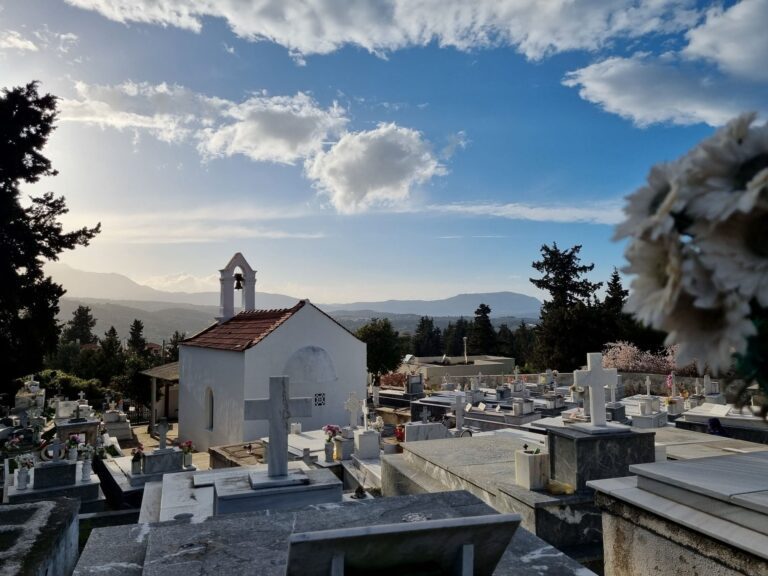
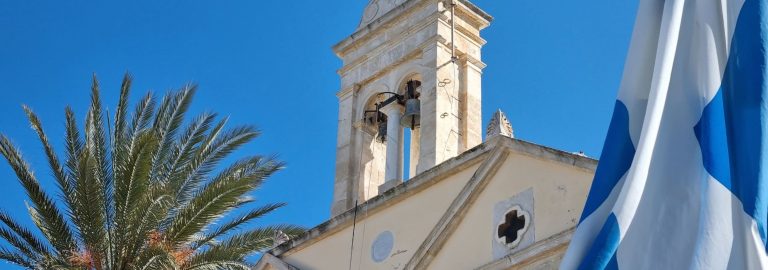
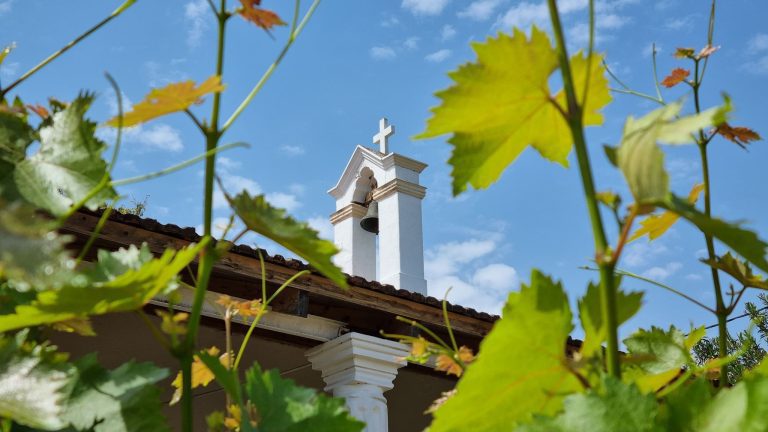
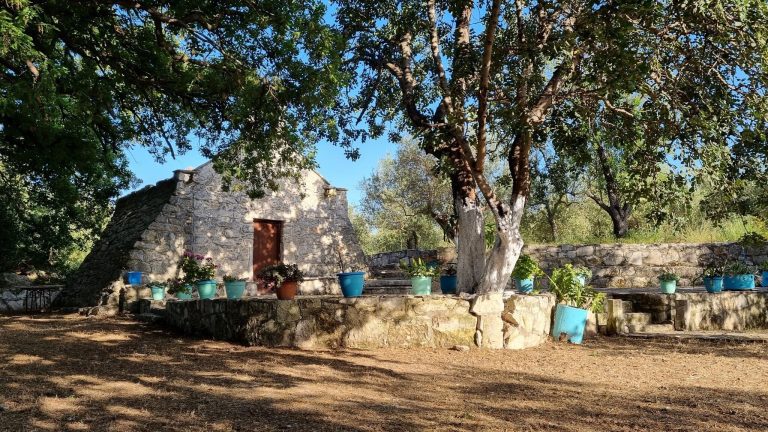
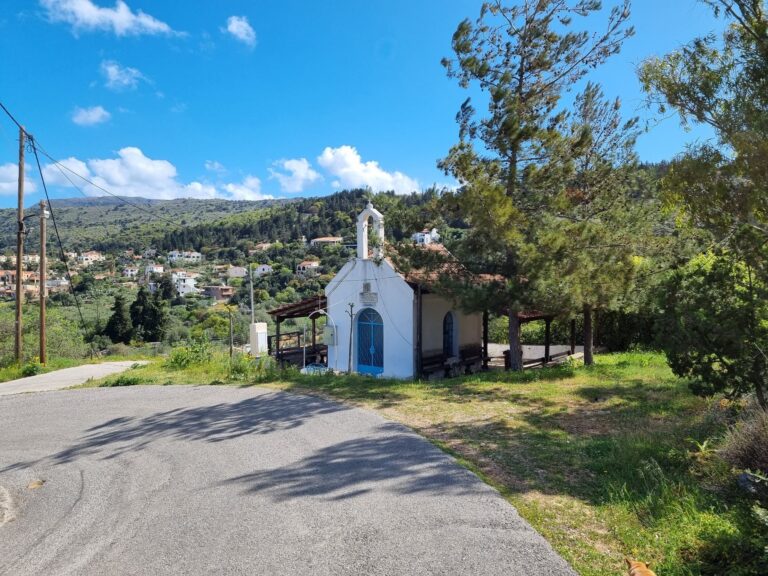
A very old church dating back at least to the 17th century, the Church of Saint Anthony incorporates a small cave in its construction and was where Christians prayed secretly during Turkish rule. The cemetery in the front part of the courtyard is no longer used—villagers are now buried in the cemetery at the Church of Saint George. This is a church you can enter because the key is usually left in the lock on the door.
To reach this church, start in the main square of Gavalochori and follow the stone-paved road in the village to the Folklore Museum. Continue past the museum and go past the Church of Saints Sergius and Bacchus and the small pine forest. Where the road branches, with one branch going to the old school, take the right branch, which takes you straight ahead and up the hill. Follow this road as it winds around and then descends toward a stream bed. On the right side of the road, not far before the stream bed, you will see a small road that leads to the church. The church is not visible from this road.
In the late 17th century, when the convent at the nearby Church of Saint John was destroyed by the Turks, the nuns who lived there fled to the Church of Saint Anthony and settled there. They rebuilt the church, dug a cistern, and built cells for their living quarters. Nuns continued to be associated with the church over the next two centuries. One report states that between 1850 and 1865, three nuns lived at the church, keeping goats, hens, and turkeys. They were involved in making textiles and had workshops in their cells where they spun wool, cotton, and linen.
The church was renovated in 1865 with funding from two Gavalochori residents in memory of their fathers, both of whom were named Antonios.
The Church of Saint Anthony is named for a Christian monk born in 251 AD in Egypt. There are many saints named Anthony, so he is often known as Saint Anthony of Egypt, Saint Anthony of the Desert, or Saint Anthony the Hermit to distinguish him from others such as Saint Anthony of Padua. The Saint Anthony (Agios Antonios, Άγιος Αντώνιος) of the church in Gavalochori was born to wealthy landowner parents but gave away or sold their property after they died and donated the funds to the poor. He then lived an ascetic life in the desert, where he ate only bread, salt, and water and often fasted for several days at a time. He fought various temptations through the power of prayer. After 15 years of this life, Saint Anthony determined to live in absolute solitude, so he enclosed himself in an abandoned Roman fort for 20 years and had food thrown to him over the wall.
In about 305, Saint Anthony emerged from his retreat in response to the pleas of the residents of a colony of ascetics who lived around the fort and wanted him to be their spiritual guide. He devoted several years to the instruction and organization of the monks before withdrawing once again to the desert. The community of monks that formed around Saint Anthony was the inspiration for similar communities throughout Egypt and elsewhere. The biography that Athanasius of Alexandria wrote about Saint Anthony, Life of Anthony, which was translated into several languages and became something of a bestseller in its day, also helped spread the concept of Christian monasticism. As a result, Saint Anthony is sometimes known as the Father of Monasticism.
Saint Anthony is appealed to by people who are seeking cures from infectious diseases, particularly skin diseases. In the past, many diseases that manifest as skin rashes, including ergotism and shingles, were referred to as Saint Anthony’s fire.
Saint Anthony’s name or feast day is January 17, and religious services are celebrated the evening before and the morning of this day in the church. The evening service begins at about 7:00 and the morning service at about 7:30.
A very old church dating back at least to the 17th century, the Church of Saint Anthony incorporates a small cave in its construction and was where Christians prayed secretly during Turkish rule. The cemetery in the front part of the courtyard is no longer used—villagers are now buried in the cemetery at the Church of Saint George. This is a church you can enter because the key is usually left in the lock on the door.
To reach this church, start in the main square of Gavalochori and follow the stone-paved road in the village to the Folklore Museum. Continue past the museum and go past the Church of Saints Sergius and Bacchus and the small pine forest. Where the road branches, with one branch going to the old school, take the right branch, which takes you straight ahead and up the hill. Follow this road as it winds around and then descends toward a stream bed. On the right side of the road, not far before the stream bed, you will see a small road that leads to the church. The church is not visible from this road.
In the late 17th century, when the convent at the nearby Church of Saint John was destroyed by the Turks, the nuns who lived there fled to the Church of Saint Anthony and settled there. They rebuilt the church, dug a cistern, and built cells for their living quarters. Nuns continued to be associated with the church over the next two centuries. One report states that between 1850 and 1865, three nuns lived at the church, keeping goats, hens, and turkeys. They were involved in making textiles and had workshops in their cells where they spun wool, cotton, and linen.
The church was renovated in 1865 with funding from two Gavalochori residents in memory of their fathers, both of whom were named Antonios.
The Church of Saint Anthony is named for a Christian monk born in 251 AD in Egypt. There are many saints named Anthony, so he is often known as Saint Anthony of Egypt, Saint Anthony of the Desert, or Saint Anthony the Hermit to distinguish him from others such as Saint Anthony of Padua. The Saint Anthony (Agios Antonios, Άγιος Αντώνιος) of the church in Gavalochori was born to wealthy landowner parents but gave away or sold their property after they died and donated the funds to the poor. He then lived an ascetic life in the desert, where he ate only bread, salt, and water and often fasted for several days at a time. He fought various temptations through the power of prayer. After 15 years of this life, Saint Anthony determined to live in absolute solitude, so he enclosed himself in an abandoned Roman fort for 20 years and had food thrown to him over the wall.
In about 305, Saint Anthony emerged from his retreat in response to the pleas of the residents of a colony of ascetics who lived around the fort and wanted him to be their spiritual guide. He devoted several years to the instruction and organization of the monks before withdrawing once again to the desert. The community of monks that formed around Saint Anthony was the inspiration for similar communities throughout Egypt and elsewhere. The biography that Athanasius of Alexandria wrote about Saint Anthony, Life of Anthony, which was translated into several languages and became something of a bestseller in its day, also helped spread the concept of Christian monasticism. As a result, Saint Anthony is sometimes known as the Father of Monasticism.
Saint Anthony is appealed to by people who are seeking cures from infectious diseases, particularly skin diseases. In the past, many diseases that manifest as skin rashes, including ergotism and shingles, were referred to as Saint Anthony’s fire.
Saint Anthony’s name or feast day is January 17, and religious services are celebrated the evening before and the morning of this day in the church. The evening service begins at about 7:00 and the morning service at about 7:30.
| Cookie name | Active |
|---|