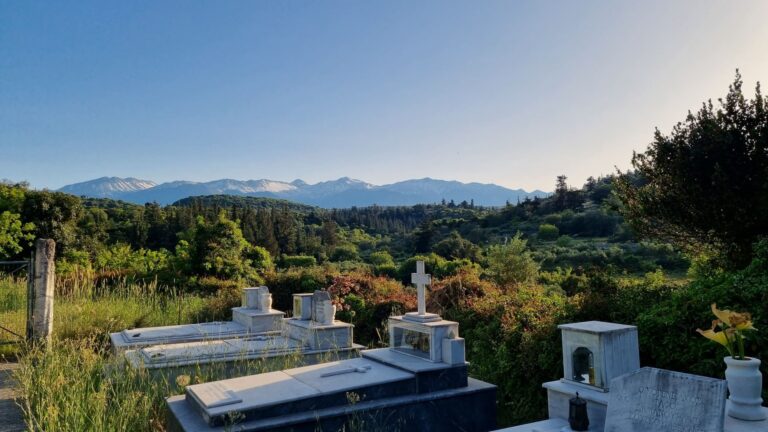
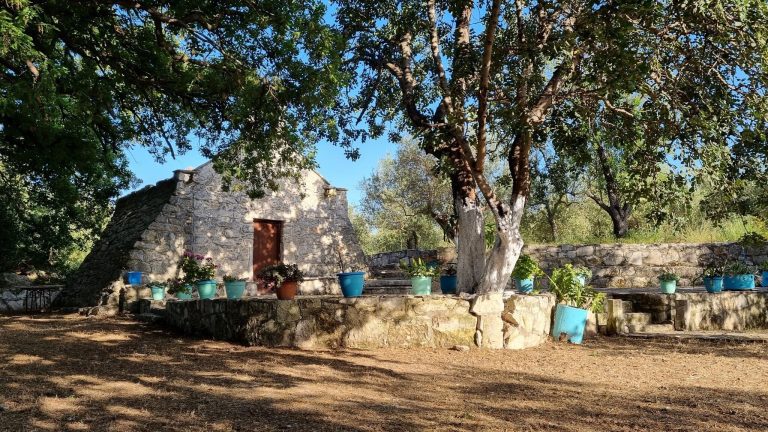
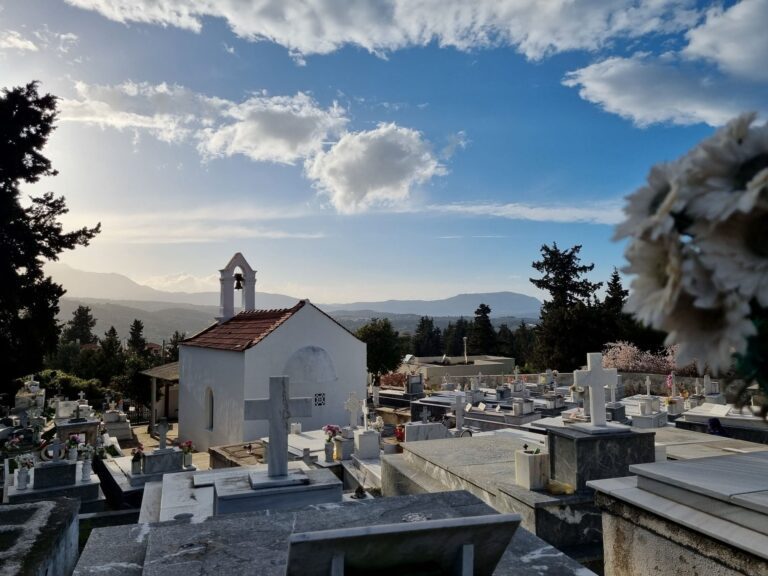
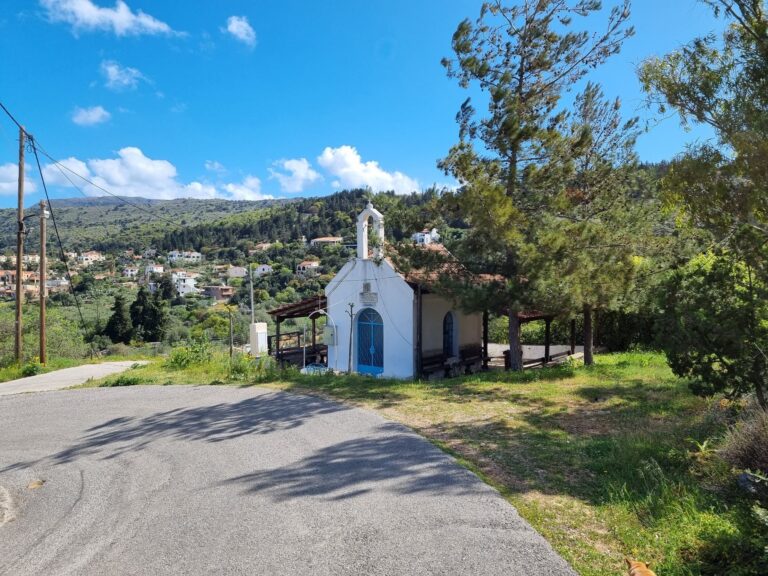
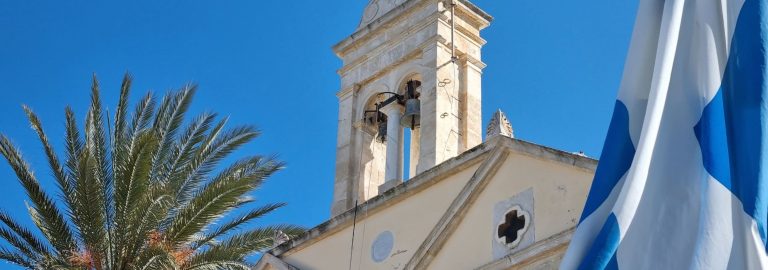
On the main road between Gavalochori and Agios Pavlos, you will find the Church of the Holy Cross, a white church with ivory trim. It is technically located in Agios Pavlos now but was once a part of Gavalochori, so it is still claimed by Gavalochori as one of its churches. A large magnolia tree guards the cemetery at the back that is no longer in use. Most notable about this church is that it is the burial place of the famous Cretan fighter Konstantinos Malinos, whose tomb is enclosed by a black metal fence at the side of the church. Malinos took part in the Cretan revolutions against the Turks of 1866 and 1878 and also served as the mayor of the village of Vamos. This church is usually locked, so you won’t be able to see inside unless a service or ceremony is taking place in it.
From the main square in Gavalochori, follow the signs directing you to Vamos (Βάμος). Stay on this road until you reach the main intersection of Agios Pavlos (Άγιος Παύλος). The Church of the Holy Cross is on your left at that intersection.
Little is known about the history of this church except that an iconostasis or icon stand stood in the spot and served as a kind of temple prior to the building of the formal church in 1877.
The Holy Cross for which this church is named refers to the cross on which Jesus was crucified. It is alleged to have been discovered by Saint Helen (Agia Eleni, Αγία Ελένη), the mother of Saint Constantine (Agios Konstantinos, Άγιος Κωνσταντίνος) and an empress of the Roman Empire. In her later years, she visited Jerusalem and was able to identify the place where Jesus had been crucified. When the earth was dug up at the site, three crosses were revealed, one thought to belong to Jesus and the others to the two thieves who died alongside him. To test which of the crosses belonged to Jesus, a severely ill or dead person was touched with the three crosses and was instantly healed or brought back to life when touched by the third one. Thus, it was believed to be the cross of Jesus. The largest collection of pieces of this cross—13—are held in the main church of the Xeropotamou Monastery on Mount Athos in northeastern Greece.
The name or feast day of the Church of the Holy Cross is September 14, and religious services are celebrated the evening before and the morning of this day in the church. The evening service begins at about 7:00 and the morning service at about 7:30.
On the main road between Gavalochori and Agios Pavlos, you will find the Church of the Holy Cross, a white church with ivory trim. It is technically located in Agios Pavlos now but was once a part of Gavalochori, so it is still claimed by Gavalochori as one of its churches. A large magnolia tree guards the cemetery at the back that is no longer in use. Most notable about this church is that it is the burial place of the famous Cretan fighter Konstantinos Malinos, whose tomb is enclosed by a black metal fence at the side of the church. Malinos took part in the Cretan revolutions against the Turks of 1866 and 1878 and also served as the mayor of the village of Vamos. This church is usually locked, so you won’t be able to see inside unless a service or ceremony is taking place in it.
From the main square in Gavalochori, follow the signs directing you to Vamos (Βάμος). Stay on this road until you reach the main intersection of Agios Pavlos (Άγιος Παύλος). The Church of the Holy Cross is on your left at that intersection.
Little is known about the history of this church except that an iconostasis or icon stand stood in the spot and served as a kind of temple prior to the building of the formal church in 1877.
The Holy Cross for which this church is named refers to the cross on which Jesus was crucified. It is alleged to have been discovered by Saint Helen (Agia Eleni, Αγία Ελένη), the mother of Saint Constantine (Agios Konstantinos, Άγιος Κωνσταντίνος) and an empress of the Roman Empire. In her later years, she visited Jerusalem and was able to identify the place where Jesus had been crucified. When the earth was dug up at the site, three crosses were revealed, one thought to belong to Jesus and the others to the two thieves who died alongside him. To test which of the crosses belonged to Jesus, a severely ill or dead person was touched with the three crosses and was instantly healed or brought back to life when touched by the third one. Thus, it was believed to be the cross of Jesus. The largest collection of pieces of this cross—13—are held in the main church of the Xeropotamou Monastery on Mount Athos in northeastern Greece.
The name or feast day of the Church of the Holy Cross is September 14, and religious services are celebrated the evening before and the morning of this day in the church. The evening service begins at about 7:00 and the morning service at about 7:30.
| Cookie name | Active |
|---|