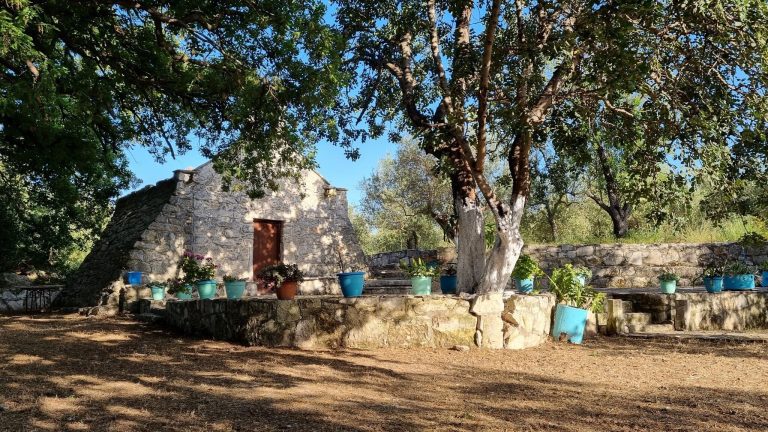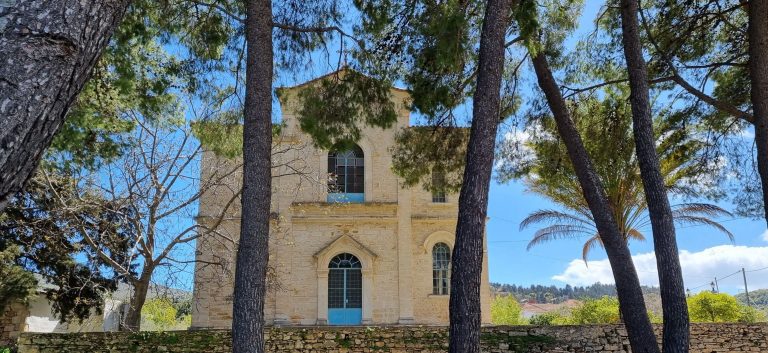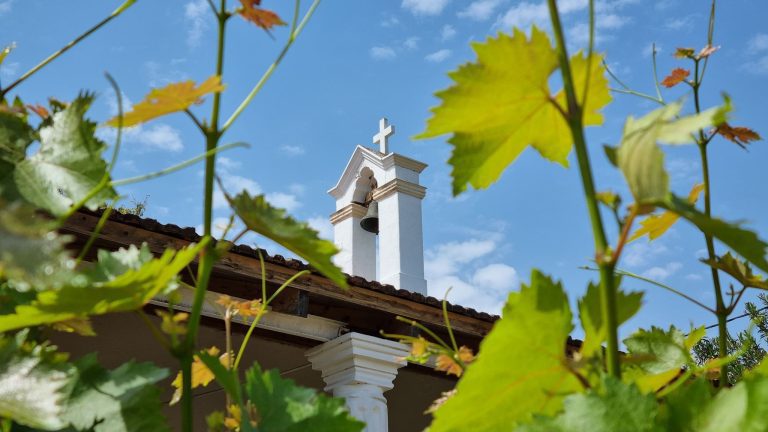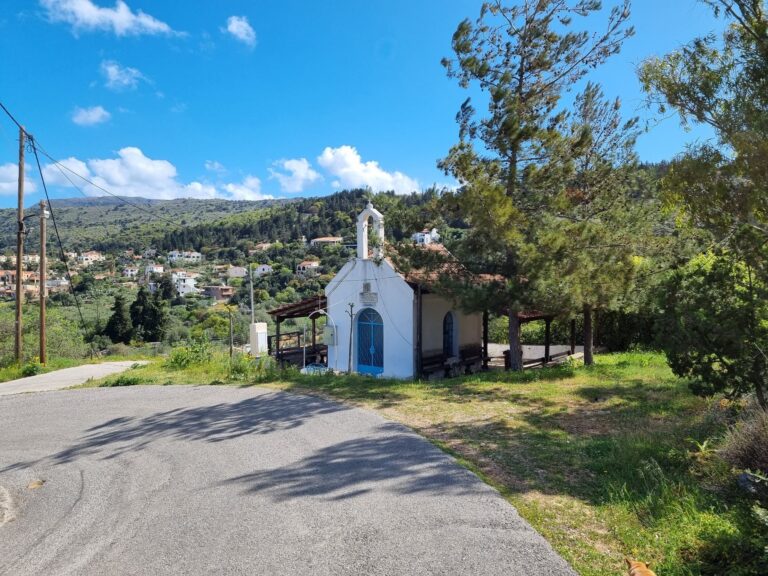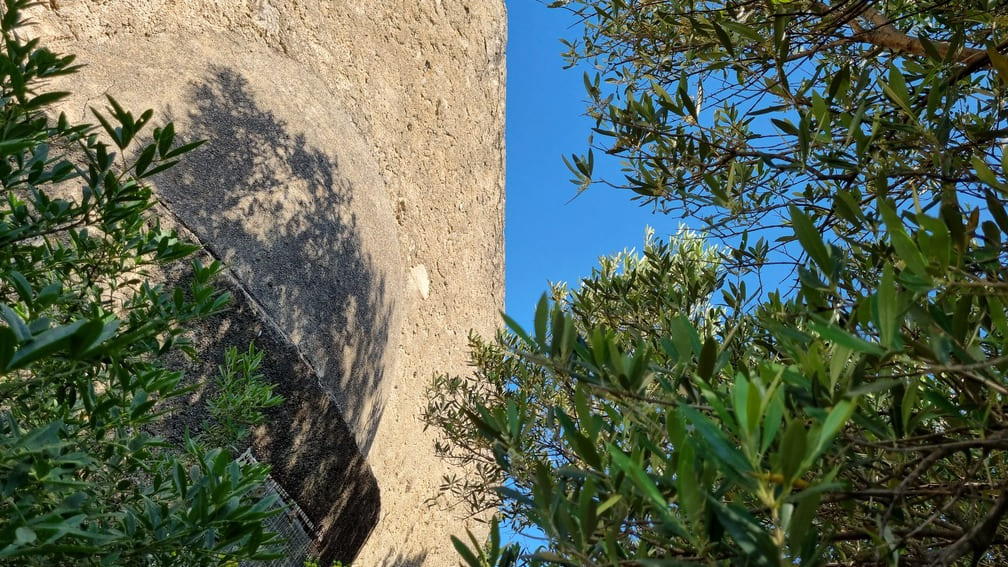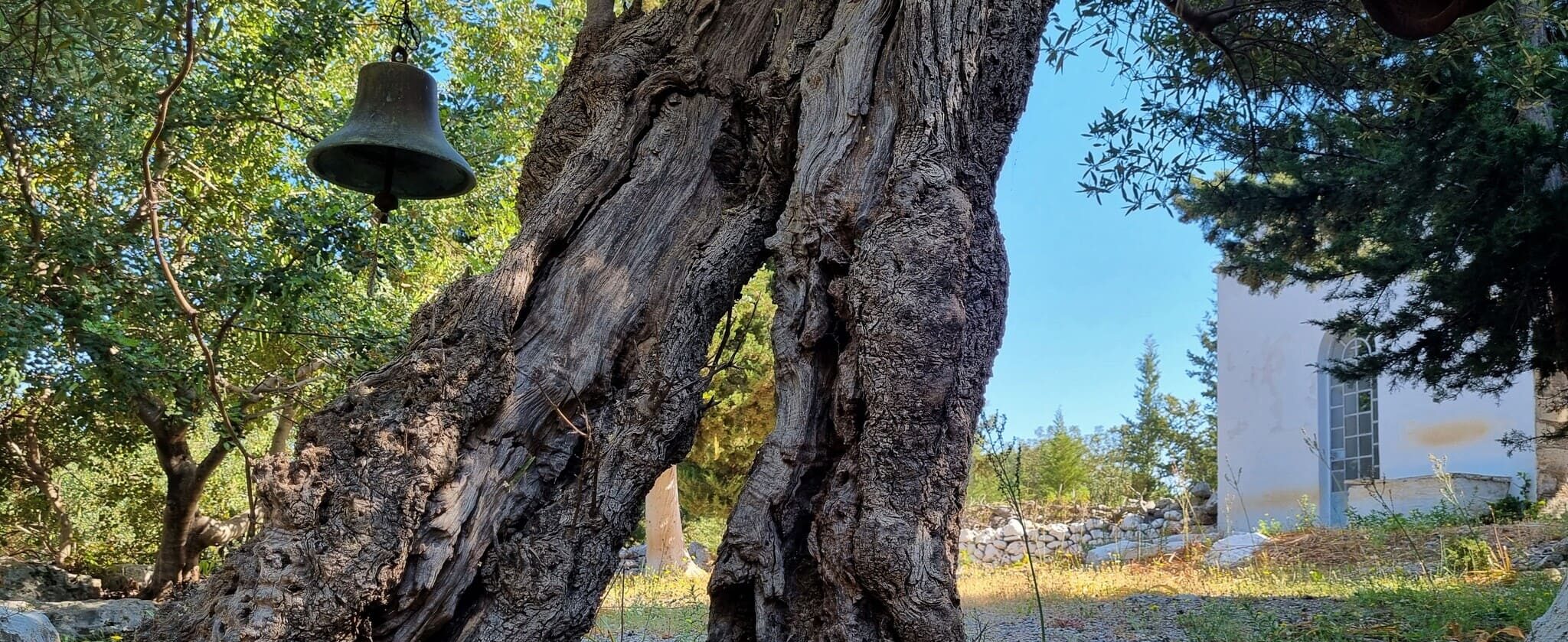
One of the first churches built in Gavalochori, the Church of Prophet Elijah is distinctive in that its front-facing wall is white plaster, but its other outer walls are bare stone. There is a key in the lock, so feel free to go inside and look around.
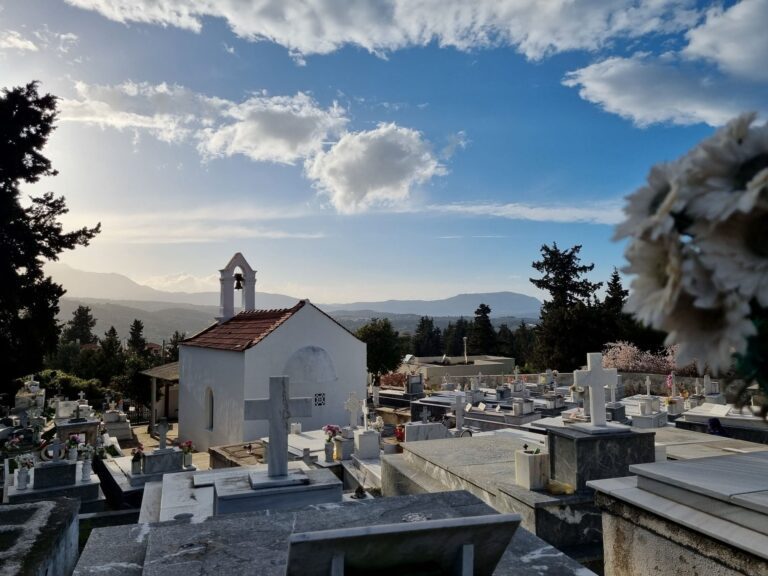
The Church of Prophet Elijah is probably the most difficult of all of the churches in Gavalochori to find, but this will get you started: From the main square in Gavalochori, follow the signs directing you up the hill to the Venetian Wells. Go past the Venetian Wells until you arrive at an intersection adjacent to a small church and a cemetery (this is the Church of Saint George). Veer left at the intersection and travel down what is the back road to Almyrida (Αλμυρίδα); don’t turn right to Xirosterni (Ξηροστέρνι). On the right-hand side of the road, you’ll encounter a handmade memorial of concrete, steel, and glass. This is the point at which the road to the church intersects. There are also signs at that intersection pointing to “Villa Fos” and “Villa Selene.” The small uphill road to the church is directly across from the gate to Villa Selene.
The Church of Prophet Elijah dates back at least to the 17th century because it was destroyed by Turks in the latter part of that century. It may have lain in ruins for many decades because a priest, Ioannis Koutouridakis, is said to have conducted a ceremony in the ruins of this church on the day of his ordination, separating the interior with a sheet to form the altar. The Turks intersected with this church again in 1866, when they killed the fighter Kokolis Cheilas, who was fighting in or very near the church during the battle of Gavalochori. In that same year, part of the church was rebuilt. In 1933, the section of the church near the altar was repaired through a fundraiser among the villagers, and the church underwent a more complete rebuilding on its old foundations in 1965.
This church is dedicated to Prophet Elijah (Profitis Ilias, Προφήτης Ηλίας), who lived in what is now Israel in the 9th century BC. Throughout his life, he dedicated himself to worship of the Hebrew God and performed or was the recipient of many miracles. Prophet Elijah was fed and kept alive by ravens and angels, initiated and ended a drought, resurrected a dead child, multiplied the flour and oil of a widow so that they were never depleted during a famine, parted and walked across the Jordan River, and brought fire down from the sky to light a sacrificial altar that had been drenched in water. He is said to have been taken alive into heaven in a fiery chariot, so in iconography, Prophet Elijah is depicted ascending into heaven in a chariot that is harnessed to four winged horses and surrounded by flames. Thus, he is known as the protector and patron saint of aviators. Because he is also a master of the elements of rain, thunder, and lightning (demonstrated when he initiated and ended a drought), he is prayed to for deliverance from drought and to ask for seasonable weather.
Prophet Elijah’s name or feast day is July 20, and religious services are celebrated the evening before and the morning of this day in the church. The evening service begins at about 7:00 and the morning service at about 7:30.
One of the first churches built in Gavalochori, the Church of Prophet Elijah is distinctive in that its front-facing wall is white plaster, but its other outer walls are bare stone. There is a key in the lock, so feel free to go inside and look around.
The Church of Prophet Elijah is probably the most difficult of all of the churches in Gavalochori to find, but this will get you started: From the main square in Gavalochori, follow the signs directing you up the hill to the Venetian Wells. Go past the Venetian Wells until you arrive at an intersection adjacent to a small church and a cemetery (this is the Church of Saint George). Veer left at the intersection and travel down what is the back road to Almyrida (Αλμυρίδα); don’t turn right to Xirosterni (Ξηροστέρνι). On the right-hand side of the road, you’ll encounter a handmade memorial of concrete, steel, and glass. This is the point at which the road to the church intersects. There are also signs at that intersection pointing to “Villa Fos” and “Villa Selene.” The small uphill road to the church is directly across from the gate to Villa Selene.
The Church of Prophet Elijah dates back at least to the 17th century because it was destroyed by Turks in the latter part of that century. It may have lain in ruins for many decades because a priest, Ioannis Koutouridakis, is said to have conducted a ceremony in the ruins of this church on the day of his ordination, separating the interior with a sheet to form the altar. The Turks intersected with this church again in 1866, when they killed the fighter Kokolis Cheilas, who was fighting in or very near the church during the battle of Gavalochori. In that same year, part of the church was rebuilt. In 1933, the section of the church near the altar was repaired through a fundraiser among the villagers, and the church underwent a more complete rebuilding on its old foundations in 1965.
This church is dedicated to Prophet Elijah (Profitis Ilias, Προφήτης Ηλίας), who lived in what is now Israel in the 9th century BC. Throughout his life, he dedicated himself to worship of the Hebrew God and performed or was the recipient of many miracles. Prophet Elijah was fed and kept alive by ravens and angels, initiated and ended a drought, resurrected a dead child, multiplied the flour and oil of a widow so that they were never depleted during a famine, parted and walked across the Jordan River, and brought fire down from the sky to light a sacrificial altar that had been drenched in water. He is said to have been taken alive into heaven in a fiery chariot, so in iconography, Prophet Elijah is depicted ascending into heaven in a chariot that is harnessed to four winged horses and surrounded by flames. Thus, he is known as the protector and patron saint of aviators. Because he is also a master of the elements of rain, thunder, and lightning (demonstrated when he initiated and ended a drought), he is prayed to for deliverance from drought and to ask for seasonable weather.
Prophet Elijah’s name or feast day is July 20, and religious services are celebrated the evening before and the morning of this day in the church. The evening service begins at about 7:00 and the morning service at about 7:30.
| Cookie name | Active |
|---|